
If you're buying a property, planning an extension or preparing a planning application, one of the first things you should check is whether the property is located within a conservation area.
Many homeowners only discover this after speaking with their architect or submitting a planning application. By then, design work may already be complete, leading to delays, redesign costs or additional planning requirements.
Fortunately, checking whether a property is within a conservation area is relatively straightforward, provided you know where to look.
In this guide, we'll explain how to check a property's conservation area status, what it means for your project and why using an accurate conservation area map can save time later in the planning process.
What is a conservation area?
A conservation area is an area designated by a local planning authority because of its special architectural or historic interest.
Rather than protecting a single building, conservation areas protect the overall character of a neighbourhood, village, town centre or historic landscape.
They may include:
- Historic streets
- Traditional buildings
- Parks and open spaces
- Historic shopfronts
- Important views
- Boundary walls
- Public spaces
There are more than 10,000 conservation areas across England, with additional designated areas throughout Scotland, Wales and Northern Ireland.
Why does it matter?
Being inside a conservation area doesn't prevent development.
However, it often means additional planning controls apply.
These may affect:
- Extensions
- Roof alterations
- Replacement windows
- External cladding
- Demolition
- New outbuildings
- Solar panels
- Boundary walls
- Trees
Knowing this early allows architects and homeowners to design proposals that are more likely to receive planning approval.
How can I check if a property is in a conservation area?
There are several ways.
1. Use a Conservation Area Map
The quickest and most reliable method is to use a dedicated Conservation Area Map.
A professional map clearly shows:
- Conservation area boundaries
- The exact location of your property
- Nearby designated heritage assets
- Surrounding planning context
Rather than searching through multiple council webpages, you can immediately see whether your site falls inside or outside the designated boundary.
2. Check your local council
Most local authorities publish conservation area maps.
However, every council uses different mapping systems.
Some are easy to use.
Others require multiple downloads or PDF plans that aren't particularly user-friendly.
Boundaries can also be difficult to interpret if you're unfamiliar with planning maps.
3. Check planning constraints together
Conservation areas rarely exist on their own.
Your property may also be affected by:
- Listed buildings
- Tree Preservation Orders
- Article 4 Directions
- Flood risk
- Green Belt
- Listed building setting
- Heritage assets
Checking these constraints together gives a much better understanding of planning risk before work begins.
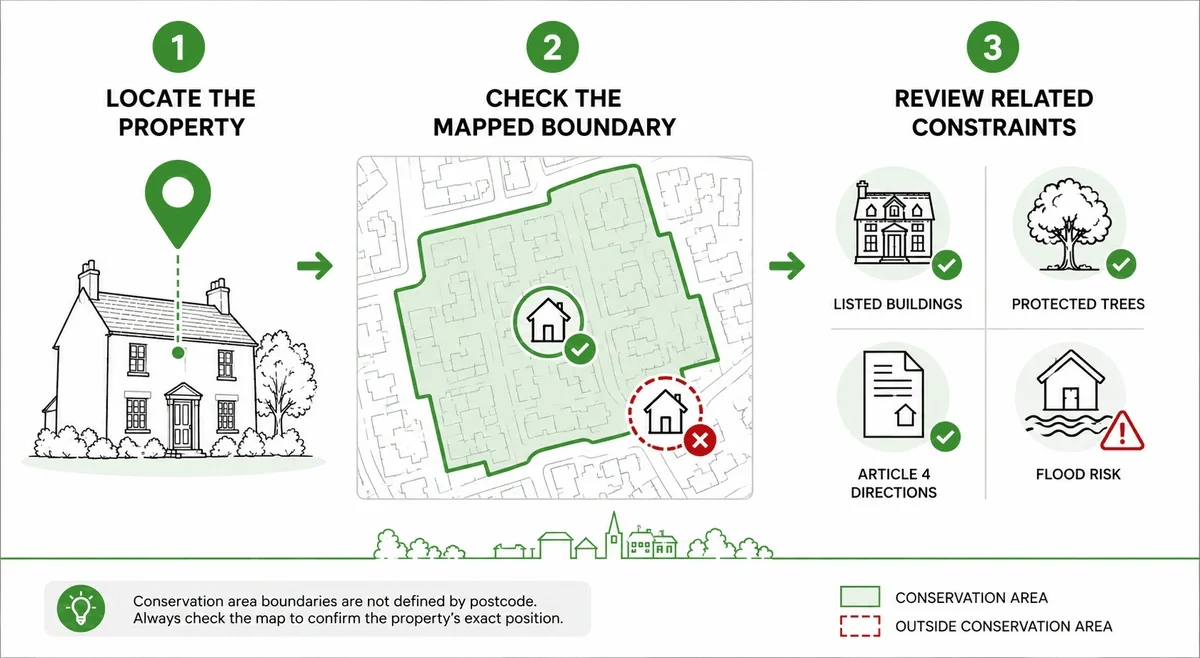
Why the postcode isn't always enough
Many people assume typing their postcode into a search engine will tell them everything they need to know.
Unfortunately, it isn't always that simple.
Some properties sit directly on conservation area boundaries.
Others may be outside the designation but still affect the setting of a conservation area or nearby listed building.
Accurate mapping is therefore much more reliable than relying solely on an address search.
What if my property is inside a conservation area?
The next step is understanding how that affects your plans.
Being inside a conservation area doesn't automatically mean planning permission will be refused.
Instead, the local authority will assess whether your proposal preserves or enhances the character and appearance of the area.
Many applications are approved every year within conservation areas.
The key is ensuring the proposal responds appropriately to its surroundings.
Common projects affected by conservation areas
Some of the most common include:
Rear extensions
Design, materials and scale may receive greater scrutiny.
Loft conversions
Roof alterations can affect important views and rooflines.
Window replacements
Traditional timber sash windows are often preferred over modern alternatives.
Demolition
Removing buildings or boundary walls may require additional permissions.
Trees
Many trees within conservation areas receive automatic protection.
Works may require prior notification before they can proceed.
Why architects check conservation areas first
For architects and planning consultants, checking conservation areas is one of the earliest planning due diligence tasks.
Before preparing drawings they typically review:
- Conservation area boundaries
- Listed buildings nearby
- Local planning policies
- Article 4 Directions
- Tree Preservation Orders
- Site constraints
Doing this first reduces the likelihood of redesign later.
Conservation areas and Heritage Statements
Some proposals within conservation areas require a Heritage Statement.
A Heritage Statement explains:
- The significance of the site
- The surrounding heritage assets
- The likely impact of the proposal
- Why the development is appropriate
It provides planning officers with the information needed to assess the proposal properly.
If your project affects the character of a conservation area, a Heritage Statement may be requested.
Why use a dedicated Conservation Area Map?
While council websites provide useful information, a dedicated conservation area mapping service offers several advantages.
You can quickly identify:
- Whether the property falls within the boundary
- Nearby heritage assets
- Planning context
- Constraints affecting the site
- Information needed before instructing architects or consultants
For developers assessing multiple sites, this can significantly reduce time spent gathering planning information.
Frequently Asked Questions
How do I know if my house is in a conservation area?
The easiest way is to check an accurate Conservation Area Map or your local authority's mapping system.
Does being in a conservation area stop me extending my house?
No.
Many extensions are approved within conservation areas, although additional design considerations usually apply.
Are trees protected in conservation areas?
Many trees receive automatic protection.
You normally need to notify the local authority before carrying out work.
Can I replace my windows?
Possibly.
The local authority may expect replacement windows to match the original appearance, particularly in prominent locations.
Do I need a Heritage Statement?
Not always.
However, proposals affecting conservation areas or nearby heritage assets may require one as part of the planning application.
Check your property before you design
Understanding whether your property sits within a conservation area should be one of the first steps in any planning project.
Checking early helps identify planning constraints before drawings are prepared, reducing the risk of delays, redesigns and additional planning costs.
MapServe's Conservation Area Map allows architects, homeowners, developers and planning consultants to identify conservation area boundaries quickly and accurately before work begins.