
Before you prepare a planning application, it is worth asking one simple question:
Could heritage constraints affect this site?
That question matters whether you are extending a house in a conservation area, altering a listed building, developing land near a historic asset, or preparing early feasibility advice for a client. Heritage issues are not always obvious from a site visit. A building may not be listed, but it may still sit within the setting of a listed building. A site may look ordinary, but it may fall inside a conservation area. A small design change may appear minor, but it could affect historic character, views, materials or the way a place is experienced.
A heritage constraints check helps you spot those risks early.
It does not replace a Heritage Statement where one is required. Instead, it helps you understand whether one is likely to be needed, what the statement should address, and which heritage issues could affect the design, validation or determination of the application.
For architects, planning consultants, surveyors and developers, this early check can save time, reduce redesign risk and help avoid avoidable planning delays.
Before preparing a Heritage Statement, it is worth checking whether the site is affected by listed buildings, conservation areas, scheduled monuments, locally listed assets or nearby heritage setting issues. A heritage constraints check helps identify these risks early, before drawings are finalised or the application is submitted.
If your site is affected by a listed building, conservation area or heritage setting issue, MapServe can prepare a planning-ready Heritage Statement to support your application.
What is a heritage constraints check?
A heritage constraints check is an early review of whether a site is affected by heritage-related planning constraints.
It usually looks at whether the site is:
- a listed building
- within the setting of a listed building
- inside or close to a conservation area
- near a scheduled monument
- affected by a registered park or garden
- within a historic landscape or heritage-sensitive area
- subject to local heritage policies
- close to non-designated heritage assets
- likely to require a Heritage Statement, Heritage Impact Assessment or additional supporting information
The aim is not simply to produce a list of nearby heritage assets. The useful part is understanding what those constraints mean for the planning application.
For example, a nearby listed building may not be a problem if the proposal has no meaningful effect on its setting. But if the development changes views, scale, access, enclosure, materials or historic relationships between buildings, it may need careful explanation in the planning submission.

Why check heritage constraints before design work goes too far?
Heritage constraints are often discovered too late.
A designer prepares a scheme. A client approves the drawings. The application is assembled. Then the local planning authority requests a Heritage Statement or raises concerns about conservation area impact, listed building setting or historic character.
At that point, the team may need to pause, gather evidence, revise the design or prepare additional documentation. That can mean extra cost, lost time and an awkward conversation with the client.
A heritage constraints check at the start of the project helps answer practical questions:
- Is the site inside a conservation area?
- Is there a listed building nearby?
- Could the proposal affect the setting of a heritage asset?
- Does the council’s validation checklist require a Heritage Statement?
- Are there local conservation area appraisals or heritage policies to consider?
- Should the design avoid certain materials, roof forms, openings or massing?
- Is more detailed heritage input needed before submission?
This is especially useful during feasibility, pre-application work, early design, due diligence or client onboarding.
Heritage constraints that can affect a planning application
Different heritage constraints create different planning risks. The most common are listed buildings, conservation areas and setting issues, but they are not the only ones.
Listed buildings
Listed buildings are protected because of their special architectural or historic interest. Works that affect the character of a listed building may require listed building consent as well as planning permission.
The key point is that listed status can affect more than the main visible frontage. Interior features, later additions, curtilage structures and historic fabric may all be relevant. Even small alterations can become sensitive if they affect what makes the building significant.
A heritage constraints check should identify whether the property itself is listed and whether the proposed works are likely to affect its significance.
Conservation areas
A conservation area is an area recognised for special architectural or historic interest. Planning decisions within conservation areas often consider whether development preserves or enhances the area’s character or appearance.
For applicants, the issue is not only whether the building is individually historic. A modern property inside a conservation area can still be affected by conservation policies. Design, materials, scale, roof form, boundary treatments, windows, shopfronts and demolition can all become relevant.
Checking conservation area boundaries early is important because being just inside or just outside the boundary can change the planning requirements.
Setting of heritage assets
The setting of a heritage asset is one of the most commonly underestimated issues.
A proposal does not need to physically touch a listed building or conservation area to affect it. Development nearby may affect views, townscape, landscape context, approach routes, enclosure, prominence or the relationship between historic buildings and their surroundings.
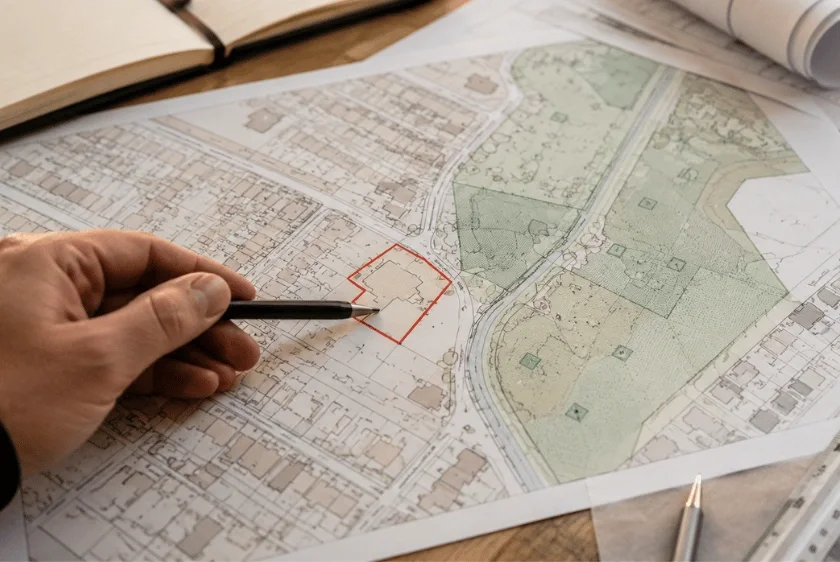
This is where accurate mapping is particularly useful. A site plan, location plan, historic map and constraints map can help show the relationship between the application site and nearby heritage assets.
Scheduled monuments and archaeology
Scheduled monuments and areas of archaeological sensitivity can introduce additional risk, especially for groundworks, foundations, infrastructure, basements or larger development sites.
A constraints check should highlight whether the site is close to known archaeological or scheduled assets and whether further assessment may be required.
Registered parks, gardens and historic landscapes
Some sites are affected by wider historic landscapes rather than individual buildings. Registered parks and gardens, designed landscapes and historic views can all influence planning decisions.
For larger schemes, the relationship between the proposed development and the wider landscape may need to be assessed carefully.
Non-designated heritage assets
Not all heritage assets are nationally listed. Local planning authorities may identify locally listed buildings, buildings of townscape merit, historic shopfronts, locally important landscapes or other non-designated heritage assets.
These can still affect planning decisions, particularly where local policy gives them weight.
When does a heritage constraints check become a Heritage Statement?
A constraints check tells you what heritage risks exist. A Heritage Statement explains them properly for the planning application.
You are likely to need a Heritage Statement if the proposal affects:
- a listed building
- the setting of a listed building
- a conservation area
- a scheduled monument
- a registered park or garden
- a locally identified heritage asset
- an area where the local authority specifically requests heritage information
A Heritage Statement usually describes the site, identifies relevant heritage assets, assesses their significance, explains the proposed works and considers the impact on that significance.
The important distinction is this:
A constraints check helps you decide what needs attention. A Heritage Statement provides the planning-ready assessment.
For simple schemes, the Heritage Statement may be proportionate and concise. For complex or sensitive sites, it may need more detailed heritage consultancy input.
For a broader explanation of what to include, read our guide: Heritage Statement: everything you need to know.
How mapping supports a better heritage constraints check
Heritage constraints are spatial. That means maps matter.
A written list of assets is useful, but it does not always show the planning risk clearly. A map can show:
- whether the site falls inside a conservation area
- how close listed buildings are to the proposal
- whether the site is inside, outside or partly across a constraint boundary
- how topography may affect views and setting
- whether the proposal sits within a historic street pattern
- how the site has changed over time
- whether other planning constraints overlap with heritage issues
For example, a site may be affected by both a conservation area and flood risk. Another may sit near protected trees, a listed building and a tight boundary. Looking at these constraints together gives the project team a better view of planning risk before the design is fixed.
This is where MapServe’s mapping and planning intelligence approach is useful. Instead of treating heritage as an isolated issue, the site can be reviewed alongside wider planning constraints such as flood risk, Tree Preservation Orders, listed buildings, conservation areas, Article 4 Directions, Green Belt and environmental constraints.
Accurate planning maps, help show the relationship between the application site, nearby heritage assets and other planning constraints.
A practical heritage constraints checklist
Use this checklist before preparing drawings, submitting an application or ordering a Heritage Statement.
1. Check whether the site is listed
Start with the property itself. Confirm whether the building, structure or site is listed. If it is, consider whether the proposed works affect character, fabric, layout, features or setting.
Do not assume that only external changes matter. Internal changes can also be sensitive where they affect historic fabric or special interest.
2. Check whether the site is in a conservation area
Confirm the conservation area boundary. A site close to the boundary may still be relevant, but being inside the boundary usually creates clearer policy implications.
Look for the council’s conservation area appraisal or management plan where available. These documents often identify features, views, materials and patterns of development that the council wants to protect.
3. Check nearby listed buildings
Do not stop at the red line boundary. Review nearby listed buildings and consider whether the proposal could affect their setting.
This is particularly important for upward extensions, new dwellings, rear extensions, infill development, demolition, new access points and changes to boundary treatments.
4. Review historic maps
Historic mapping can help explain how the site and surrounding area developed over time.
This can be useful where the proposal involves older buildings, former outbuildings, historic routes, boundary walls, yard layouts, gardens or former industrial land. Historic maps can also help distinguish between original features and later changes.
5. Check local heritage policies
National policy is important, but local policy often shapes how applications are assessed. Local plans, neighbourhood plans, conservation area guidance and design codes may all include heritage requirements.
For planning consultants and architects, checking local policy early can help avoid generic statements that fail to address what the council actually cares about.
6. Identify overlapping constraints
Heritage rarely exists in isolation.
A site may also be affected by TPOs, flood risk, Article 4 Directions, Green Belt, protected views, landscape designations or environmental constraints. These can influence the design response and the supporting documents needed for validation.
7. Decide whether a Heritage Statement is needed
Once the constraints are clear, decide whether the application needs a Heritage Statement.
If the site affects heritage significance, setting or conservation area character, it is usually safer to provide a proportionate statement rather than wait for the council to request one later.
Common mistakes when checking heritage constraints
The biggest mistake is checking only whether the building is listed.
Many applications run into heritage issues because the site is near a listed building, inside a conservation area or affected by local heritage policy. These issues may not be obvious from the address alone.
Other common mistakes include:
- relying only on a basic web search
- missing conservation area boundary details
- ignoring the setting of nearby heritage assets
- failing to check local validation requirements
- using poor-quality or outdated plans
- treating the Heritage Statement as a history essay
- not connecting the assessment to the actual proposed works
- discovering constraints after the design has already been agreed
A good heritage constraints check should be practical. It should help the team understand what the design needs to respond to and what the planning submission needs to explain.
Example: why a small proposal may still need heritage input
Imagine a homeowner wants to replace windows on a property in a conservation area.
The building is not listed. The works are modest. At first glance, it may seem like a straightforward application.
However, the council may still care about:
- window material
- glazing bar pattern
- opening style
- colour
- relationship to neighbouring properties
- whether the change preserves or enhances the conservation area
- whether Article 4 restrictions apply
In this case, the issue is not the size of the project. It is the effect on historic character.
A short, proportionate Heritage Statement may help explain the existing context, the proposed change and why the works are appropriate.
Example: why setting matters outside the site boundary
Now imagine a small infill development on land next to a listed farmhouse.
The application site is not listed. The new dwelling does not touch the listed building. But the proposal may still affect how the farmhouse is experienced, especially if it changes views, enclosure, access, scale or the historic relationship between the building and surrounding land.
This is a setting issue.
A constraints check should flag the nearby listed building early so the design can respond before the planning application is submitted.
How MapServe can help
MapServe helps architects, planners, surveyors, developers and land professionals bring mapping and planning intelligence together at the start of a project.
For heritage-related planning work, MapServe can support:
- site location and planning maps
- historic mapping
- conservation area and listed building context
- planning constraints checks
- CAD-ready mapping for design workflows
- Heritage Statements for suitable projects
If your site is affected by heritage constraints, MapServe can prepare a planning-ready Heritage Statement to support your application.
Our Heritage Statement service includes a heritage designation review, policy context, assessment of significance, impact assessment and planning conclusion, with historic mapping included where relevant.
You may also find our guide to maps for planning applications useful when preparing the wider submission pack.
Conclusion
Heritage constraints should be checked before design work goes too far.
For architects, planning consultants and developers, the value is not just knowing whether a listed building or conservation area exists. The real value is understanding what that means for the application, the design, the supporting documents and the risk of delay.
A good heritage constraints check helps you move from uncertainty to a clearer planning strategy.
If your site is in or near a conservation area, listed building or other heritage asset, a Heritage Statement may be required. Checking early gives you a better chance of submitting a complete, well-evidenced application first time.
Need a planning-ready assessment? Order a Heritage Statement from MapServe.
FAQs
What is a heritage constraints check?
A heritage constraints check reviews whether a site is affected by listed buildings, conservation areas, scheduled monuments, historic landscapes, local heritage assets or other heritage-related planning risks.
Is a heritage constraints check the same as a Heritage Statement?
No. A constraints check identifies heritage risks. A Heritage Statement explains the significance of affected heritage assets and assesses the impact of the proposed development.
Do I need a Heritage Statement if my building is not listed?
Possibly. You may still need one if the site is in a conservation area, near a listed building, affects a heritage asset’s setting or is covered by local validation requirements.
Why does listed building setting matter?
Setting matters because development near a listed building can affect how its significance is understood or experienced, even if the listed building itself is not physically altered.
Can mapping help with heritage planning risk?
Yes. Mapping helps show boundaries, proximity, site context, historic development, constraints and relationships between the proposal and nearby heritage assets.